When you first begin looking for your wedding dress, you may come across a number of different terms: off-the-peg, made-to-order, made-to-measure, customised, custom and bespoke.
It can be difficult to know exactly what each of these terms means, particularly when different bridal designers and boutiques may use them in slightly different ways.
You may be told that a dress can be “customised”, that it is “made especially for you”, or even that it is “bespoke”. But what does that actually mean?
And, importantly, what are you paying for?
The difference between these services isn't simply about the price of the finished wedding dress. It is about where the design begins, how much of the gown is created specifically for you, how the pattern is developed, how many fittings are involved and how much design and craftsmanship goes into creating the final gown.
At Kate Edmondson Bridal Couture, I believe it is important that brides understand these differences before making such a significant and personal investment.
So, let's look at each option.
Off-the-Peg Wedding Dresses
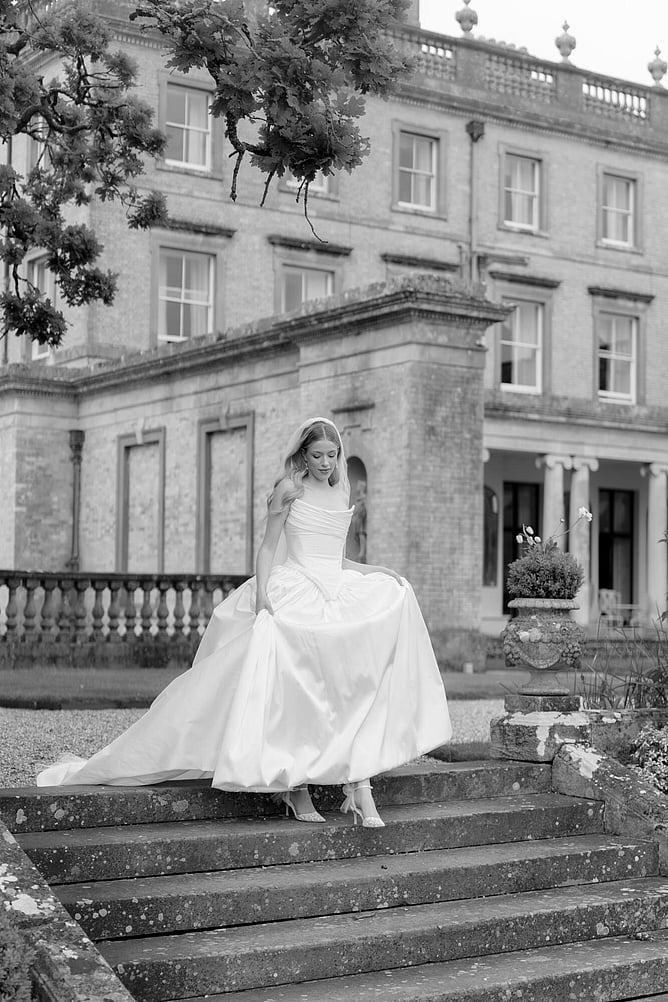
An off-the-peg wedding dress, sometimes called a ready-to-wear gown, is an existing dress that has already been designed and produced.
You visit a bridal boutique or designer, try on the available gowns and choose the style you love. The dress is then purchased in the closest available size and alterations can be made to achieve the best possible fit.
The important thing to understand is that the design already exists.
The neckline, silhouette, construction, fabric and overall proportions have already been decided. The dress isn't being designed around you; instead, the existing gown is altered to fit you.
This can be a wonderful option if you find a dress that makes you feel instantly like a bride and doesn't require significant changes.
It can also be a more straightforward route if you have a shorter timeframe, as the design itself already exists.
What does the price include?
With an off-the-peg gown, you are primarily paying for the existing dress.
However, it is important to remember that the price of the gown may not be the complete cost.
Alterations, bustle work, changes to straps or necklines, shortening, taking in or letting out and other adjustments may all be additional.
So when comparing dresses, I always recommend looking at the overall investment, rather than simply comparing the initial price of the gown.
A dress priced at £3,000 may look very different in value once alterations and additional work have been added.
Made-to-Order Wedding Dresses
Made-to-order is a term that can be particularly confusing because it sounds very personal.
A made-to-order wedding dress is generally an existing design that is produced once you place your order, rather than a gown being taken from existing stock.
In other words, the gown may be made for you, but the design itself was not necessarily created for you.
The designer already has the collection, the design and usually the pattern. Once you choose your gown, it is then produced in the required size and, depending on the designer, perhaps in a choice of fabric or colour.
Some made-to-order designers may also offer limited alterations or design options.
For example, you might be able to choose a particular sleeve, change the colour or make a small adjustment to the design.
The exact service varies between designers, which is why it is always worth asking what is included.
Why does made-to-order cost more than off-the-peg?
With an off-the-peg gown, the dress already exists.
With made-to-order, a new gown has to be produced for you.
That additional production naturally forms part of the price.
However, the design and pattern development have already been completed by the designer. You are not paying for an entirely new design to be created from the beginning.
This is one of the important distinctions between made-to-order and bespoke.
What Does “Customised” or “Custom” Wedding Dress Mean?
This is where things can become a little less straightforward.
A customised wedding dress usually starts with an existing design, but elements of that design can be changed.
Perhaps you have fallen in love with a particular gown but would prefer a different neckline.
Maybe you would like sleeves added, the train altered, a different fabric used or a detail changed.
These changes can make the dress feel much more personal to you.
But customised doesn't necessarily mean bespoke.
The important question is:
How much of the original design remains, and is a new pattern being created specifically for you?
For example, imagine that a designer has an existing gown with a square neckline. You love the silhouette but would prefer a bateau neckline.
If the designer takes the existing pattern and modifies it to create your chosen neckline, you are having an existing design customised.
That can be a wonderful service and may be exactly what you are looking for.
But it is different from starting with a blank sheet of paper and developing an entirely new gown around your individual brief.
And this is why I would always encourage a bride to look beyond the terminology.
So, What Does Bespoke Really Mean?
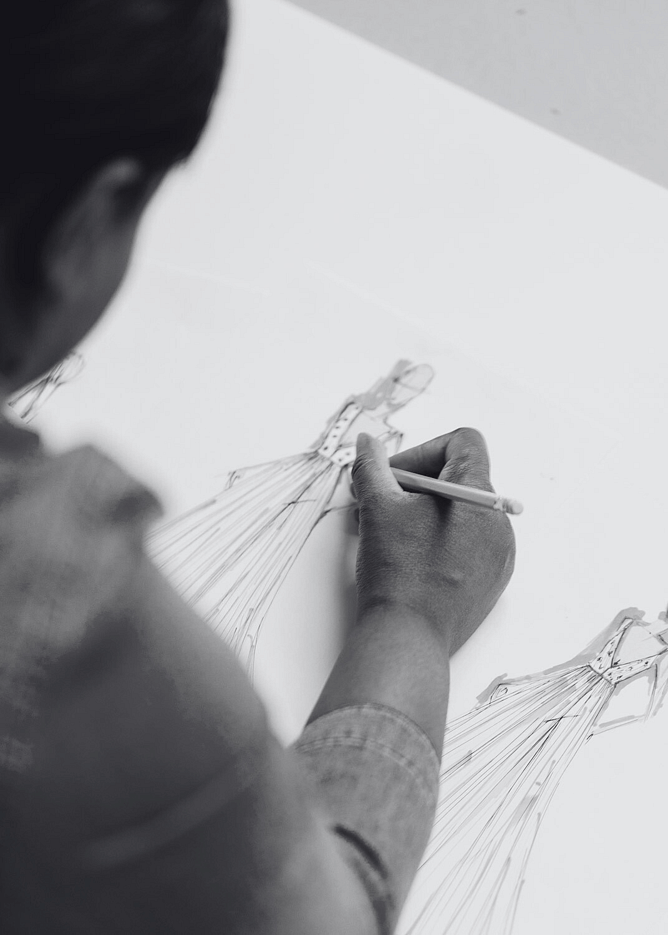
A bespoke wedding dress begins with you.
Rather than choosing an existing gown and modifying it, the design is developed specifically around your ideas, your proportions, your personality and your wedding.
There may be inspiration from dresses you have seen, details you love, fabrics you have discovered or silhouettes that you have always imagined yourself wearing.
But the finished gown doesn't simply reproduce an existing design.
It is developed as an individual piece.
For me, this is what makes the bespoke process so special.
The first consultation isn't simply about taking measurements or choosing a dress.
It is about understanding the bride.
How does she want to feel on her wedding day?
What does she love about fashion?
What does she normally wear?
What is important about her wedding?
Where is the ceremony taking place?
How does she want the dress to move?
Are there details that have a personal meaning?
All of these things can influence the design.
The Pattern Is Part of the Design
One of the most important differences between an existing gown and a truly bespoke gown is the pattern.
With an existing collection dress, the pattern has already been created.
With a bespoke gown, the pattern can be developed specifically for the individual bride and the design we are creating together.
This allows the proportions, shape and construction of the gown to be considered from the very beginning.
It is one of the reasons that bespoke is much more than simply taking measurements and making a dress in a particular size.
The Importance of the Toile
Another important stage in a bespoke process is the toile.
A toile is a preliminary version of the gown, traditionally made from calico.
It allows us to see the developing shape of the dress on the bride before cutting into the final fabric.
This is where we can look carefully at the proportions, neckline, silhouette, balance and fit.
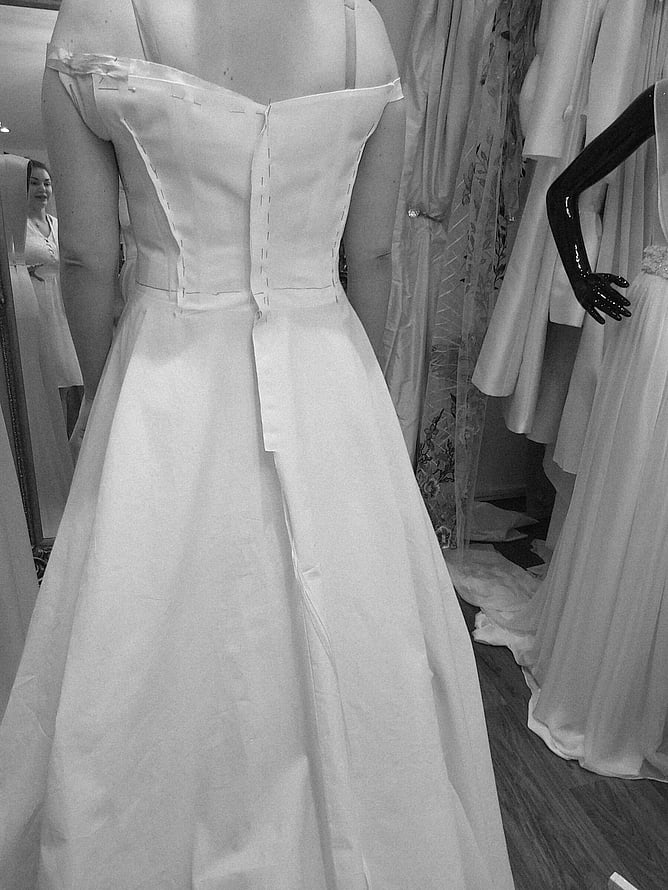
The toile can then be altered and refined.
Perhaps the neckline needs to be slightly higher.
Perhaps the waist needs to sit differently.
Perhaps the proportion of the skirt needs to change.
Perhaps the shape of the back needs to be softened.
These are not problems. They are part of the creative process.
The purpose of the toile is to allow the design to evolve before the final gown is made.
From Toile to Final Gown
Once the design and fit have been refined, the final fabric can be cut and the gown constructed.
This is where the difference between a photograph of a finished dress and the process behind it becomes particularly important.
A finished gown may look effortless.
But behind that simplicity can be hours of pattern cutting, fitting, construction and finishing.
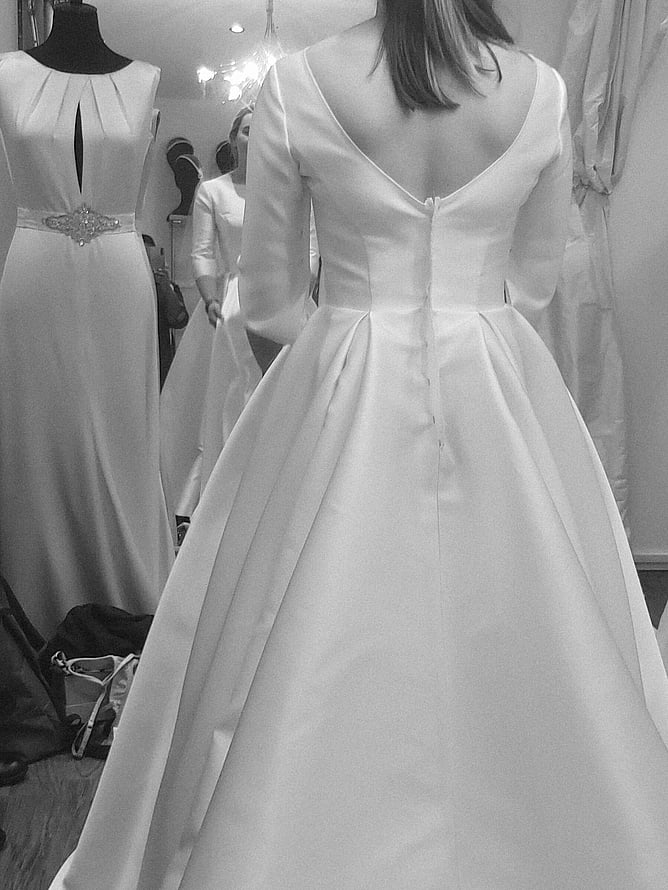
The process continues through further fittings as the gown develops.
The fit is refined, details are checked and the individual elements of the dress are brought together.
For the bride, this means that she isn't simply waiting for a dress to arrive.
She is part of the process of creating it.
Why Does Bespoke Cost More?
This is perhaps one of the most important questions a bride can ask.
If you have seen a beautiful wedding dress for £3,000 and another for £6,000, it can be tempting to simply ask why one costs twice as much as the other.
But price isn't determined by the finished appearance alone.
Two dresses can look relatively simple from the outside while involving very different amounts of design, construction and craftsmanship.
With bespoke, the investment can include the time and expertise involved in developing:
the design
the individual pattern
the toile
the fabric selection
multiple fittings
pattern adjustments
construction
finishing
hand-finished details
the final fitting
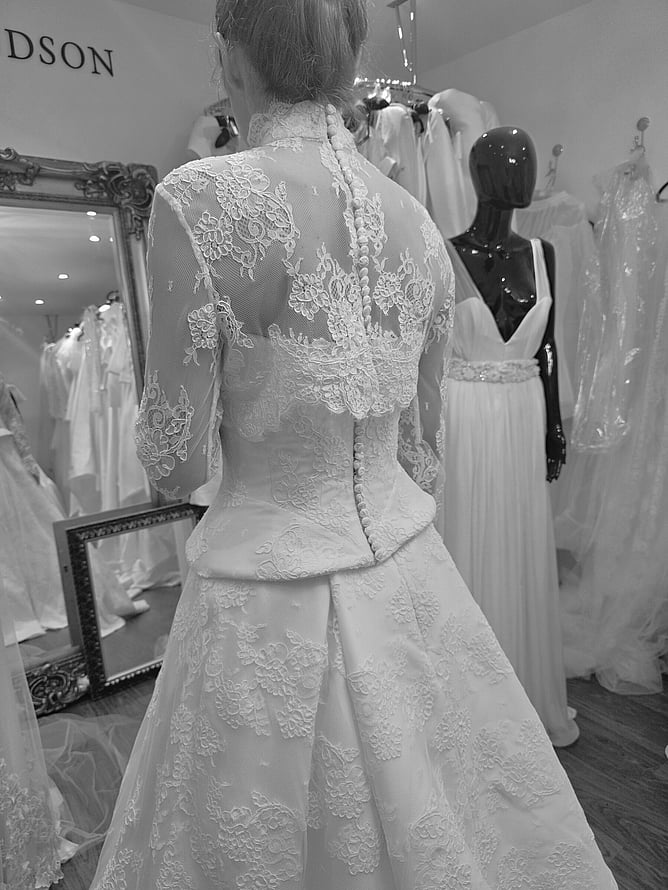
You are therefore not simply paying for a finished wedding dress.
You are investing in the creation of your wedding dress.
That distinction is important.
So How Do the Prices Compare?
There is no universal price scale across the bridal industry, and a luxury off-the-peg gown can sometimes cost more than an entry-level bespoke dress.
The price depends on the designer, the fabric, the construction, the complexity of the design, the level of craftsmanship and what is included in the service.
But as a general way of understanding the different services:
Off-the-peg
You are purchasing an existing gown, with alterations usually carried out to improve the fit.
Made-to-order
An existing design is produced for you.
Customised
An existing design is adapted to incorporate your chosen changes.
Bespoke
The design, pattern and gown are developed specifically for you.
The more individual the design and development process becomes, the more time and specialist expertise are generally involved.
This is why it is important to compare like with like when looking at prices.
Don't Just Ask “Is It Bespoke?”
Because bridal terminology can vary, I think there is a much more useful question to ask:
“What exactly is being created for me?”
If you are considering a wedding dress described as bespoke, custom or made-to-order, don't be afraid to ask how the process works.
For example:
Is this an existing design?
Will you be using an existing pattern?
Will a new pattern be created specifically for me?
Which elements of the design can I change?
Will I have a toile fitting?
How many fittings are included?
Are alterations or customisations included in the quoted price?
What happens if I want to change something during the process?
These questions aren't about challenging your designer.
They are about understanding the service you are investing in.
A good designer should be happy to explain the process clearly.
Which Wedding Dress Service Is Right for You?
There isn't one right answer.
If you have found an off-the-peg dress that you adore and it can be altered beautifully to fit you, that may be exactly the right dress.
If you love an existing designer gown and are happy with the design but want it produced especially for you, made-to-order may be the perfect choice.
If you love the foundation of a particular gown but want to make several changes, a customised design may give you the flexibility you need.
And if you have a very particular vision or simply want the experience of creating something completely individual then bespoke may be the right choice.
The important thing is that you understand what you are buying.
Bespoke Doesn't Necessarily Mean “Better”
I think this is worth saying because choosing a wedding dress should never be about being persuaded that one service is automatically superior to another.
Bespoke isn't necessarily the right choice for every bride.
If you find a beautiful existing gown that makes you feel incredible, there is no reason to change it simply because another service is called “bespoke”.
The beauty of bespoke is that it offers something different.
It gives you the opportunity to become part of the design process itself.
Your dress can evolve around your ideas, your proportions, your personality and your wedding.
For some brides, that creative process is just as important as the finished gown.
The Most Important Thing to Remember
When choosing your wedding dress, don't be guided by the label alone.
Off-the-peg, made-to-order, customised and bespoke can all offer wonderful bridal experiences.
But they are not necessarily the same service.
Look at where the design begins, how the pattern is developed, what can be changed, how many fittings are involved and what is included in the price.
Most importantly, make sure you understand what you are paying for.
At Kate Edmondson Bridal Couture, the bespoke process begins with the individual bride.
From the first conversation and initial design ideas through to pattern cutting, the calico toile, fittings, construction and final finishing, every stage is part of creating a gown that is uniquely yours.
Because your wedding dress should do more than fit you.
It should feel as though it was created for you.